Raising a Glass to Better Design: What Pub Gardens Are Teaching Britain's Residential Developers
Raising a Glass to Better Design: What Pub Gardens Are Teaching Britain's Residential Developers
There is something quietly remarkable about the British pub garden. It accommodates the solitary reader nursing a pint in the corner, the raucous birthday gathering commandeering three pushed-together tables, and every social permutation in between — all within the same modest patch of outdoor space. No architect hands out a briefing document. No management committee allocates zones. The layout simply works, and it has worked for generations.
It is this instinctive functionality that a growing cohort of residential developers and landscape architects are now studying with renewed seriousness. As communal outdoor space becomes an increasingly prominent selling point in new housing schemes — particularly in the wake of shifting post-pandemic attitudes to home and neighbourhood — the design industry is asking a pointed question: what can the geometry of Britain's most beloved social spaces teach us about building places where people actually gather?
The Social Architecture of the Pub Garden
The pub garden succeeds not because of grandeur but because of calibration. It offers what landscape architects describe as a layered privacy gradient — a spectrum of settings that range from exposed and sociable to sheltered and intimate, often within a few metres of one another.
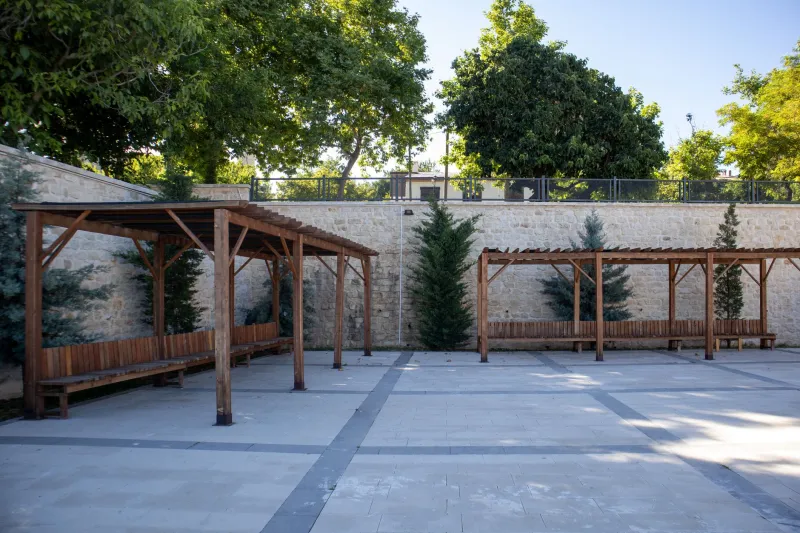
A low hedge separates one cluster of tables from another without creating a wall. A pergola draped in climbing plants offers overhead enclosure without blocking the afternoon light. Moveable seating allows occupants to self-select their degree of social exposure. These are not accidental features; they are the accumulated design intelligence of centuries of informal use, refined by trial and error rather than drawing board.
Landscape designer Clara Hennessy, whose practice has worked on residential courtyard schemes across the Midlands and South East, puts it plainly: "The pub garden doesn't ask you to behave in a particular way. It gives you enough structure to feel oriented but enough flexibility to feel free. That's extraordinarily difficult to replicate in a managed residential setting, but it's exactly what residents are telling us they want."
 Photo: South East, via wikitravel.org
Translating Conviviality Into Residential Context
The challenge for developers is that residential communal spaces carry a very different set of constraints. They must satisfy planning requirements, satisfy management company obligations, and satisfy the competing preferences of dozens or hundreds of households simultaneously. The temptation — historically well indulged — has been to default to the lowest common denominator: a flat lawn, a handful of benches, and a locked gate.
What progressive schemes are demonstrating, however, is that the pub garden's principles translate with surprising fidelity when applied thoughtfully. Informal seating clusters, arranged at slight angles to one another rather than in regimented rows, encourage the kind of incidental conversation that transforms neighbours into a community. Semi-private alcoves created through strategic planting — ornamental grasses, low-growing shrubs, timber screening — offer residents the option of occupying shared space without committing to full social participation.
Architect James Pallister, who has recently completed a mixed-tenure development in Bristol incorporating these principles, describes the process as "designing for optionality. You're not telling residents how to use the space. You're offering them a menu of experiences and trusting them to choose."
His Bristol scheme features a central courtyard divided into three distinct zones: an open lawn area suited to children's play and larger gatherings, a pergola-covered seating cluster orientated towards the afternoon sun, and a quieter planted terrace at the building's northern edge. Resident satisfaction surveys conducted six months after occupation recorded notably higher scores for communal space quality than comparable schemes in the developer's portfolio — a finding that has since informed the practice's standard approach.
The Commercial Case for Convivial Design
Beyond resident wellbeing, there is a compelling commercial argument for investing in pub-garden thinking. Sales and marketing data from several schemes that have adopted these principles suggest a measurable uplift in both sales velocity and achieved prices, particularly for ground-floor units that directly adjoin well-designed communal gardens.
The logic is intuitive. Buyers purchasing off-plan are, in effect, purchasing a lifestyle proposition as much as a physical asset. A communal space that reads as genuinely inviting — that communicates warmth, informality, and social possibility — converts that proposition more effectively than a sterile render of a symmetrical lawn ever could.
Hennessy notes that the marketing language around these spaces has shifted accordingly. "Developers are no longer talking about 'amenity space' or 'communal gardens'. They're talking about 'outdoor living rooms' and 'social terraces'. The vocabulary has caught up with what the design is actually trying to achieve."
Natural Boundaries and the Art of the Soft Edge
One of the most transferable lessons from pub garden design is the use of natural planting as a boundary mechanism. The hard fence or rendered wall — still the default solution in many residential schemes — creates a clear delineation between public and private but does so at the cost of visual warmth and ecological value.
The pub garden equivalent is the mixed hedgerow, the espaliered fruit tree along a boundary wall, or the raised planter that separates without excluding. These soft edges perform multiple functions: they define space, provide seasonal interest, support biodiversity net gain requirements, and — crucially — they age well. A well-chosen hedge becomes more attractive over time rather than less, a quality that few hard-landscaping materials can match.
For developers navigating increasingly stringent biodiversity net gain obligations under the Environment Act 2021, this approach offers an additional dividend. Integrating native species planting into communal space design can contribute meaningfully to biodiversity metrics without requiring dedicated ecological land, effectively allowing a single design decision to serve both commercial and regulatory purposes simultaneously.
Designing for the Long Term
The most enduring criticism of communal residential spaces is not their initial design but their subsequent deterioration. Spaces that photograph beautifully at handover can become neglected within a few years as management budgets are squeezed and residents disengage from spaces they never felt truly belonged to them.
Here, too, the pub garden offers instruction. The spaces that endure are those in which occupants feel a degree of ownership — where the landlord's hand is evident but not oppressive, where informal personalisation is tolerated and even encouraged. For residential schemes, this might mean designing raised bed areas that resident groups can cultivate, or leaving deliberate ambiguity in how certain zones might be used over time.
Pallister argues that this approach requires developers to resist the urge to over-specify. "The mistake is to design every square metre as if it's a show home. Leave some productive ambiguity. Let residents complete the space. That's what creates genuine attachment."
Britain's pub garden did not arrive fully formed. It evolved through generations of use, adaptation, and quiet reinvention. As residential developers look to create outdoor spaces that genuinely serve the communities they house, that evolutionary instinct — responsive, human-scaled, and unafraid of informality — may be the most valuable design principle of all.