The Greyfield Frontier: How Britain's Declining Retail Parks Are Becoming the Development Sector's Best-Kept Secret
The Greyfield Frontier: How Britain's Declining Retail Parks Are Becoming the Development Sector's Best-Kept Secret
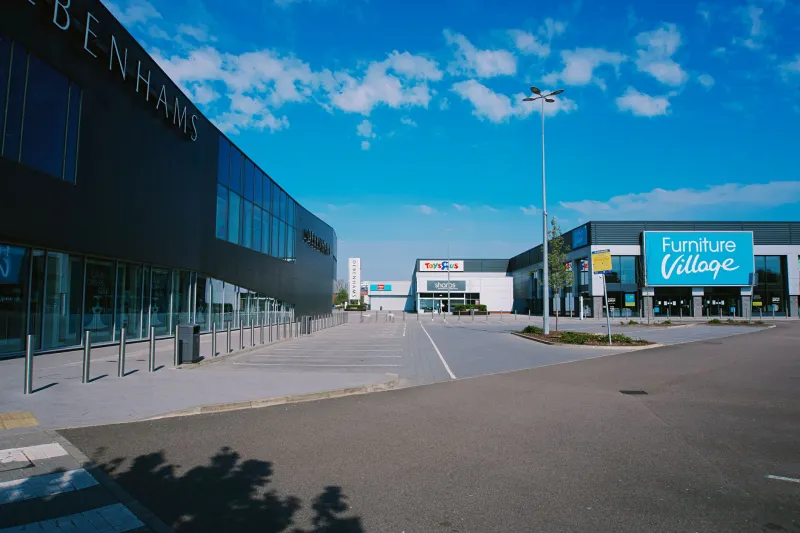
Drive the ring road of almost any British town on a weekday morning and the evidence is inescapable. Vast expanses of cracked tarmac stretch before near-empty units, their fascias faded and their car parks haunted by a fraction of the footfall their designers once anticipated. These are Britain's retail parks — and whilst the national conversation about declining commercial property has tended to fixate on the high street, a quieter but arguably more significant transformation is unfolding at the edge of town.
The numbers tell a stark story. Vacancy rates across Britain's out-of-town retail parks have risen consistently since 2019, accelerated first by the pandemic and then by the structural shift towards online retail that followed. Anchor tenants — the large-format electrical, furniture, and fashion retailers that once guaranteed footfall — have been closing or consolidating at pace. What remains, in many cases, is a single-storey built environment sitting on generously proportioned land parcels, served by existing road infrastructure, and often located within reasonable proximity of established residential communities.
For the development sector, this confluence of factors represents something rare: a brownfield opportunity that arrives pre-connected.
Understanding the Greyfield Typology
The term 'greyfield' has gained traction in planning and development circles to describe underperforming commercial land — neither the contaminated complexity of traditional brownfield nor the political sensitivity of greenfield. Retail parks occupy a particularly interesting position within this category. Unlike town-centre sites, they typically offer large, contiguous land areas free from the fragmented ownership patterns that bedevil high street regeneration. Unlike former industrial land, they rarely carry significant remediation liabilities, having been purpose-built on engineered platforms with modern drainage and utility connections already in place.
Perhaps most significantly, the infrastructure that made them attractive to retailers in the first place — dual carriageway access, bus routes, proximity to residential catchments — translates directly into development viability for residential and mixed-use schemes. A site that once moved lorry deliveries efficiently can equally accommodate construction traffic. A road network designed for weekend retail surges can serve a new community without material upgrade.
The Planning Landscape Is Shifting
For much of the past two decades, planning policy created an implicit barrier between commercial and residential land uses at the edge of town. Retail parks were designated for commercial purposes, and conversion to residential required navigating a complex, often protracted process of use-class changes and local plan amendments.
That landscape has changed materially. The government's revised National Planning Policy Framework places a clear emphasis on the efficient use of land and the delivery of housing on brownfield sites. Local planning authorities, under increasing pressure to demonstrate five-year housing land supply, are demonstrating greater appetite for mixed-use proposals that bring residential delivery to previously commercial sites. Several authorities have gone further, proactively identifying underperforming retail parks within their local plans as preferred locations for residential-led regeneration.
The introduction and subsequent expansion of permitted development rights has also created tactical options for developers willing to think creatively about phased approaches — using interim commercial uses to maintain income whilst longer-term residential consents are pursued through the formal planning system.
Engineering the Business Case
The financial case for greyfield retail park development is more nuanced than a simple comparison of existing use value against residential development value. Developers considering these sites must account for several variables that distinguish them from more straightforward brownfield opportunities.
Land acquisition in this context frequently involves negotiating with institutional landlords — pension funds, REITs, and property companies — whose motivation to sell may be tempered by long lease income from remaining tenants, however modest. Understanding the lease expiry profile of a target site is therefore fundamental to assessing the realistic development timeline and, consequently, the land price that can be justified.
Demolition and enabling costs for single-storey retail buildings are generally lower than those associated with multi-storey commercial structures, though the sheer footprint of a typical retail park means that enabling works can still represent a material line in the development appraisal. Experienced developers will factor in the value of retained infrastructure — particularly drainage, power supply, and road connections — when modelling their costs against comparable greenfield or traditional brownfield schemes.
Where the numbers become genuinely compelling is in the density achievable on a well-located retail park site. A ten-acre retail park currently generating modest income from a handful of second-tier tenants can, with the right consent, accommodate several hundred residential units alongside retained or reimagined commercial space. At current residential values in many regional markets, the uplift between existing use value and consented residential value is substantial.
Mixed-Use as the Model
The most successful greyfield retail park transformations are not those that simply replace sheds with houses. The opportunity lies in creating genuinely mixed environments that serve the surrounding community whilst delivering the density required to make schemes financially viable.
Retaining a curated element of ground-floor commercial use — café, pharmacy, convenience retail, healthcare — within a predominantly residential scheme addresses both planning authority requirements for community infrastructure and the practical needs of incoming residents. Where retail parks adjoin existing residential areas, there is often a latent demand for accessible local amenity that the original retail park format, with its car-centric design, actively failed to serve.
Public realm investment — the transformation of tarmac car parks into streets, squares, and green space — is both a planning requirement and a value-creation tool. Residential values within well-designed mixed-use schemes consistently outperform those achieved in purely residential developments of comparable specification, reflecting the premium that buyers and renters place on walkable, characterful environments.
The Patient Capital Imperative
It would be misleading to present greyfield retail park development as a swift or uncomplicated undertaking. The planning journey from initial promotion to implementable consent typically spans several years, particularly where local plan allocations must be secured before detailed applications can be progressed. Lease expiry negotiations, phased decanting of existing tenants, and the management of live commercial income during the pre-development period all demand experienced asset management capability alongside conventional development skills.
For developers and investors with the patience and expertise to navigate these complexities, however, the rewards are proportionate to the effort. Sites acquired at commercial land values and consented for residential-led mixed use represent some of the most significant value creation opportunities available in the current market.
Britain's retail parks were built for a retail economy that no longer exists in its original form. Their second chapter — as the foundations of new communities, engineered from the outset with the connectivity and infrastructure that greenfield sites must build from scratch — may prove to be considerably more enduring than their first.