Green Space, Premium Place: How Outdoor Amenity Has Become Britain's Most Powerful Residential Value Driver
A Shift That Permanent Changed the British Home
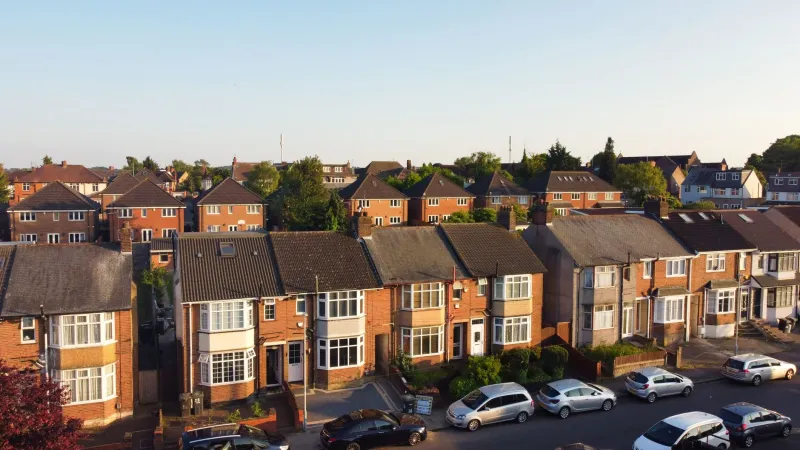
For much of the twentieth century, the British relationship with outdoor space was largely sentimental — a cultural attachment to the back garden that rarely translated into hard commercial logic at the planning stage. Developers could deliver a modest strip of turf behind a semi-detached and expect few objections. That era is over.
The pandemic years of 2020 and 2021 did not create the desire for outdoor space so much as they exposed how acutely it had been underserved. Millions of households confined to flats without balconies, or homes with north-facing concrete yards barely large enough to turn around in, experienced firsthand the consequences of decades of amenity space being treated as a residual consideration. When the market reopened, buyers moved decisively. Research published by Rightmove in the years following the initial lockdowns consistently identified outdoor space among the top three most-searched property attributes, a position it had not previously occupied with such dominance.
For residential developers, this represents both a commercial opportunity and a design obligation that cannot be deferred.
From Afterthought to Architecture
The traditional approach to amenity space in British residential schemes — particularly flatted developments — was largely reactive. Outdoor areas were whatever remained once the building footprint, car parking, and bin stores had been allocated. Communal gardens, where they existed at all, were frequently awkward in shape, poorly oriented, and lacking any meaningful sense of purpose or enclosure.
The most commercially astute developers have recognised that this approach is no longer viable. Schemes that invest in properly designed outdoor environments — with genuine solar orientation, thoughtful landscaping, defined zones for different uses, and a sense of spatial generosity — are achieving measurable valuation premiums over comparable stock that neglects these qualities.
Valuation evidence from major urban centres supports this direction of travel. Research conducted by Savills and Knight Frank in recent years has demonstrated that private outdoor space, even where modest in area, can add between five and fifteen per cent to the achieved sale price of a residential unit. In dense urban settings where private gardens are structurally impossible, well-designed roof terraces and communal gardens with genuine amenity value are demonstrating similar uplifts.
The implication for development appraisals is significant. Outdoor space is no longer a cost to be minimised; it is an investment with a quantifiable return.
Planning Policy Is Moving in the Same Direction
The commercial case for outdoor amenity space is increasingly reinforced by the policy environment. The National Planning Policy Framework has for some time emphasised the importance of well-designed places that promote health and wellbeing, but recent years have seen local planning authorities apply these principles with greater rigour and specificity.
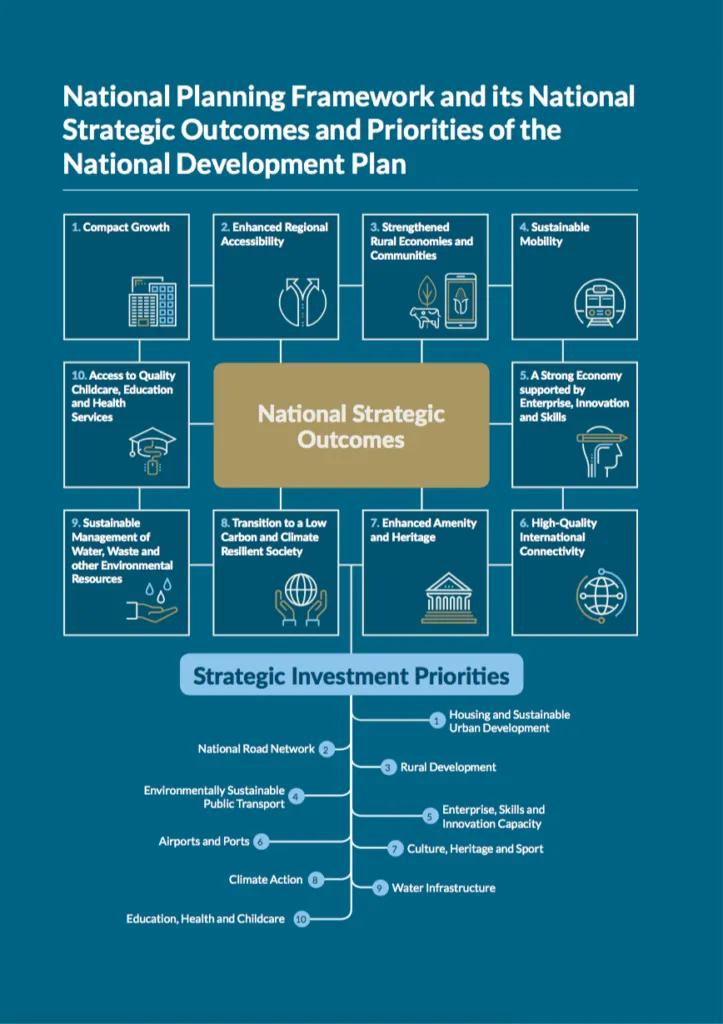 Photo: National Planning Policy Framework, via www.npf.ie
Many London boroughs, as well as a growing number of metropolitan authorities outside the capital, now apply minimum private outdoor space standards to new residential schemes. The London Plan, for instance, sets out requirements for private amenity space that vary by unit type, with larger family-sized homes expected to provide proportionally more. Schemes that fail to meet these thresholds face significant resistance at committee, regardless of their other merits.
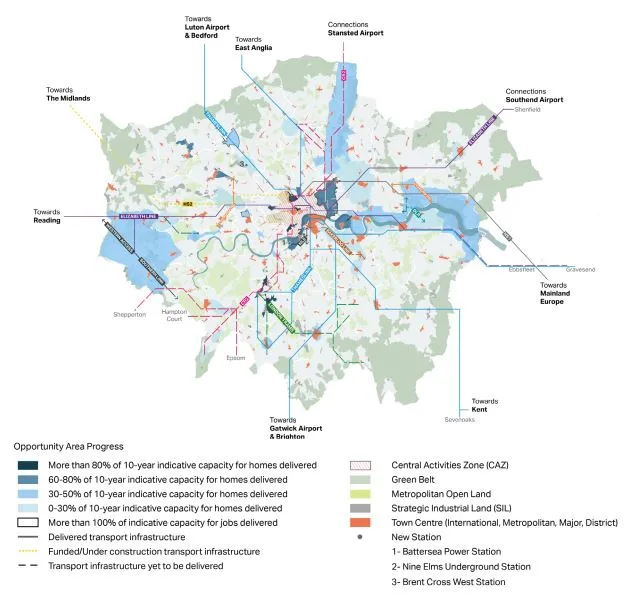 Photo: London Plan, via www.londonforum.org.uk
Beyond minimum standards, planning officers are increasingly scrutinising the quality, not merely the quantity, of proposed outdoor spaces. A south-facing communal courtyard with meaningful planting and seating provision will be viewed considerably more favourably than a technically compliant but sterile patch of grass. Developers who understand this distinction — and brief their architects accordingly — enjoy a smoother passage through the planning process.
Biodiversity net gain requirements, now mandatory for most developments under the Environment Act 2021, have added a further dimension to this conversation. Landscaping that delivers ecological value as well as human amenity is increasingly the standard to which schemes are being held, creating an alignment between planning compliance and commercial appeal that thoughtful developers can exploit.
 Photo: Environment Act 2021, via dwfgroup.com
Redesigning the Plot: Practical Implications
Translating the commercial and policy case for outdoor amenity into built outcomes requires developers to revisit some long-established assumptions about plot layout and building typology.
In suburban and edge-of-town settings, the conventional approach of maximising unit density by reducing private garden sizes is being questioned by developers who have seen the valuation consequences of under-delivering on outdoor space. There is a growing body of evidence that a scheme offering fewer units with genuinely generous gardens can outperform — in terms of total revenue — a denser scheme where buyers discount for inadequate outdoor provision.
In urban environments, the design challenge is more complex but no less important. Roof terraces have emerged as a particularly valuable tool, converting what was previously wasted structural space into premium private amenity. The engineering and waterproofing implications carry a cost, but where terraces are allocated to upper-floor units and priced accordingly, the return on that investment is well established.
Communal gardens in flatted schemes require a different approach. The most successful examples are those designed with a genuine sense of ownership and identity — spaces that feel curated and purposeful rather than merely present. Management structures that ensure ongoing maintenance and prevent gradual deterioration are equally important; a communal garden that has become overgrown and neglected within five years of completion is a liability, not an asset.
The Forward View: Amenity as a Core Commercial Lever
The trajectory is clear. As British homebuyers continue to prioritise lifestyle quality alongside spatial practicality, and as planning authorities embed outdoor amenity requirements more firmly into their decision-making, developers who treat green space as a core design parameter rather than a residual afterthought will hold a structural advantage.
This shift demands a change in how development appraisals are constructed. The cost of delivering high-quality outdoor amenity — whether through landscaping investment, structural engineering for roof terraces, or the opportunity cost of reduced unit density — should be assessed against the demonstrable revenue premium it generates, not simply treated as an overhead to be minimised.
At HMS Developments, this principle informs how we approach every residential scheme we bring forward. The pub garden of the title is an instructive metaphor: the most successful public houses have always understood that the quality of the outdoor experience is inseparable from the quality of the overall offer. Residential development, we believe, is reaching the same conclusion.